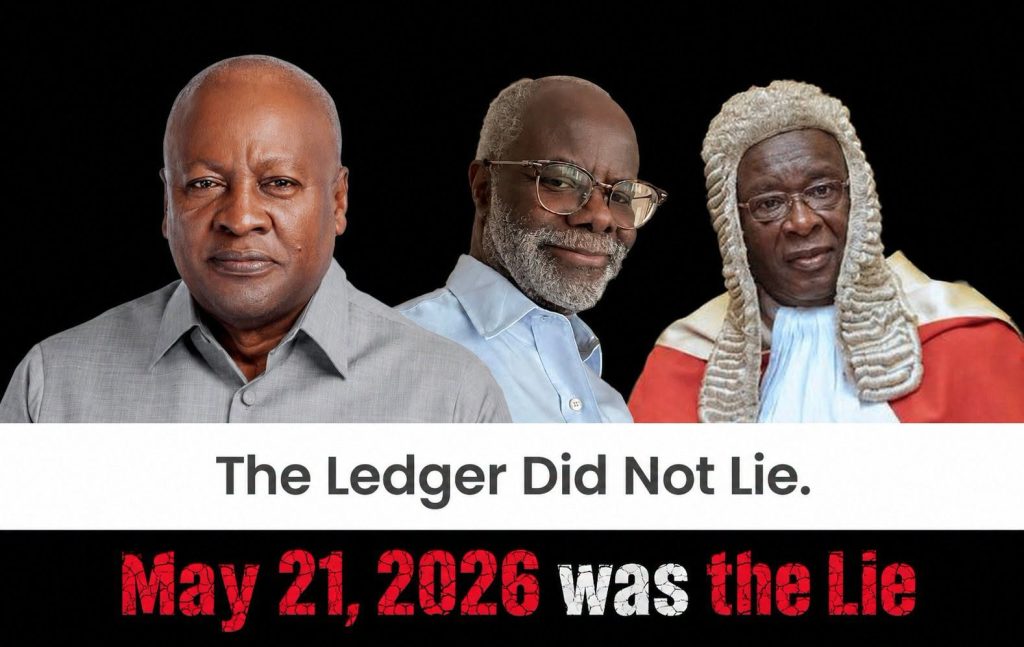
The Ledger that Revoked GN Bank’s Licence Did Not Lie. Court of Appeal Did.
Article by J. A. Sarbah
On May 21, 2026, a three-member Court of Appeal panel unanimously restored the operating licence of GN Savings and Loans, overturned the January 2024 High Court judgment, and ordered Receiver Eric Nana Nipah to hand back possession, management, and control to Dr Papa Kwesi Nduom’s Groupe Nduom. The panel’s finding: the revocation was “unfair and unreasonable.”
That is the order. Now the numbers the court refused to read.
GN Bank’s capital deficit at revocation stood at GHS683.66 million. Its Capital Adequacy Ratio was negative 61 percent against a regulatory minimum of 13 percent under Act 930. Negative. Sixty-one. Percent. That is not a bank in distress. That is a bank that had already died and was being operated as a collection vehicle for its owner’s business empire while depositors across the country were told at the counters to go and return another week for a rationed sum not exceeding GHS1,500.00.
The Court of Appeal’s central reasoning was this: the Government of Ghana owed money to Groupe Nduom’s contractor clients, and it was therefore unfair to punish GN Bank for capital inadequacy. That reasoning is not jurisprudence. It is a non sequitur dressed in appellate language. Government receivables belonging to road contractors are not GN Bank’s balance sheet assets. They are a separate legal person’s contingent claims. The Bank of Ghana does not regulate the Government’s payment of road contracts. It regulates deposit-taking institutions. The Court of Appeal collapsed that distinction and rendered a judgement on that premise, touting it as fairness to the depositors and the people of Ghana.
Here is the question the three-member panel did not answer. Any entity other than the Government of Ghana could have owed Groupe Nduom’s contractor clients. A private developer. A foreign firm. A bankrupt state enterprise. The identity of the debtor does not change the arithmetic of insolvency. The Bank of Ghana, which revoked the licence, is not the Government of Ghana. Act 918 explicitly guarantees the central bank’s operational independence from the Ministry of Finance. The government’s payment default on road contracts is not the Bank of Ghana’s regulatory failure. The court collapsed two separate legal persons – the government as debtor, the central bank as regulator – and called the collapse the basis for restoring a licence.
And there is more. Act 930 has clear provisions on how much of depositors’ funds a Specialised Deposit-Taking Institution can lend out without compromising its ability to honour customer cheques on demand. GN Bank flouted every one of those provisions. The Single Obligor Limit. The related-party exposure cap. The cash reserve requirement. The capital adequacy floor. Flouted. Deliberately. Repeatedly. The unfairness and unreasonableness that the three-member panel spoke about is not found in the Bank of Ghana’s revocation. It is found in GN Bank’s balance sheet. The court blamed the regulator for the consequences of the bank’s own choices.
The Government of Ghana owed Groupe Nduom’s contractor clients GHS30.33 million. Credit every cedi of it. Post it directly onto GN Bank’s balance sheet. The institution still carries a capital deficit of GHS653.33 million. Still structurally insolvent. Still unable to meet depositor obligations on demand. Still dead. GHS30.33 million does not move a negative 61 percent Capital Adequacy Ratio. It does not resurrect a bank. It rescues an argument that the arithmetic has already executed.
Then there is the $62.3 million the panel apparently found inconvenient to address. The Bank of Ghana documented the transfer of depositor funds to International Business Solutions, a related Groupe Nduom entity registered in the United States. Not a loan. Not a regulatory advance. A transfer. Of depositor funds. Across an ocean. To a related entity. Without documentation. A clear case of money laundering!
The Court of Appeal’s ruling restores the licence of the institution that made that transfer without demanding one sentence of explanation for where that money went and whether it is coming back.
You cannot run a bank like a personal corporate treasury and then claim regulatory persecution when the numbers don’t add up. And you are hot
Dr Nduom is an accountant. That is not a mitigating detail. It is the indictment. A trained accountant running a deposit-taking institution did not stumble into a negative 61 percent. He did not accidentally breach related-party lending thresholds. He did not absentmindedly move $62.3 million to an offshore affiliate without documentation. He knew what the Prudential Reserve Ratios Act 930 imposed. He knew the threshold. He crossed it deliberately, repeatedly, and profitably. Greed dressed in a professional qualification is not a misfortune. It is premeditation.
Justice Gifty Addo Adjei read the ledger in January 2024. She found that GN had failed to prove solvency at the time of revocation. She found that governance failures had rendered the institution incapable of meeting its debt obligations. She found the Bank of Ghana’s intervention lawful, constitutional, and reasonable. Her judgment was not a political act. It was arithmetic with a wig on. The Court of Appeal overturned it without producing a single figure that contradicts her findings. It substituted the language of fairness for the discipline of evidence and called that substitution a “unanimous decision.”
Procedural unfairness in a regulatory revocation has a remedy. That remedy is a fresh hearing conducted properly. It is not the automatic reinstatement of a licence that the institution had no right to hold. Restoring that licence does not restore GHS683.66 million in capital. It does not retrieve $62.3 million from International Business Solutions. It does not protect a single depositor. It protects one man’s business empire and dresses that protection in the language of rights.
The High Court delivered the law. The Court of Appeal pronounced on politics. Pure and simple.
Now remove the wig entirely.
Mahama’s election manifesto committed to restoring banking licences unjustly cancelled. He won. The executive route was legally closed. Act 930 and Act 918 together erect a firewall: the Bank of Ghana cannot be directed by any person or authority in its supervisory functions. The judicial route was what remained. And a Court of Appeal sitting under a Mahama presidency delivered by judicial order precisely what the campaign trail promised and the law forbade the executive from executing directly.
Nduom’s own Facebook posts, GRATITUDE FOUR, GRATITUDE TWO, and GRATITUDE FIVE sealed it all. He thanked Mahama by name for the promise made as a presidential candidate. He thanked Otumfuo, Togbe Afede, Archbishop Duncan-Williams, and Emeritus Bishops for opening their doors. He thanked the Court of Appeal for understanding his call since 2019. He did not thank the law. He did not cite a statute correctly applied. He did not reference a precedent that vindicated him. A man who spent seven years demanding legal vindication celebrated his victory without mentioning the law once. Because the law is not what delivered the restoration of the Licence.
Courts do not exist to understand calls. Courts exist to apply law to facts. A judicial panel thanked for understanding that a litigant’s call has not been adjudicated. It has responded. And when that response travels through the opened doors of Otumfuo and Archbishop Duncan-Williams, through the enabling environment of a president who made restoration a campaign promise, and lands as a unanimous appellate ruling that cannot account for GHS683.66 million or $62.3 million in transferred depositor funds, only one conclusion is available.
This is not jurisprudence. This is the campaign promise that found its courthouse.
The High Court read the ledger. The Court of Appeal delivered the campaign promise. International Business Solutions still has the $62.3 million. And Ghana’s depositors are still waiting for a court that will ask for it back.
Ghana is not safe
J. A. Sarbah



About The Author