
Finance Ministry to reject funding requests for unappraised capital projects

Accra
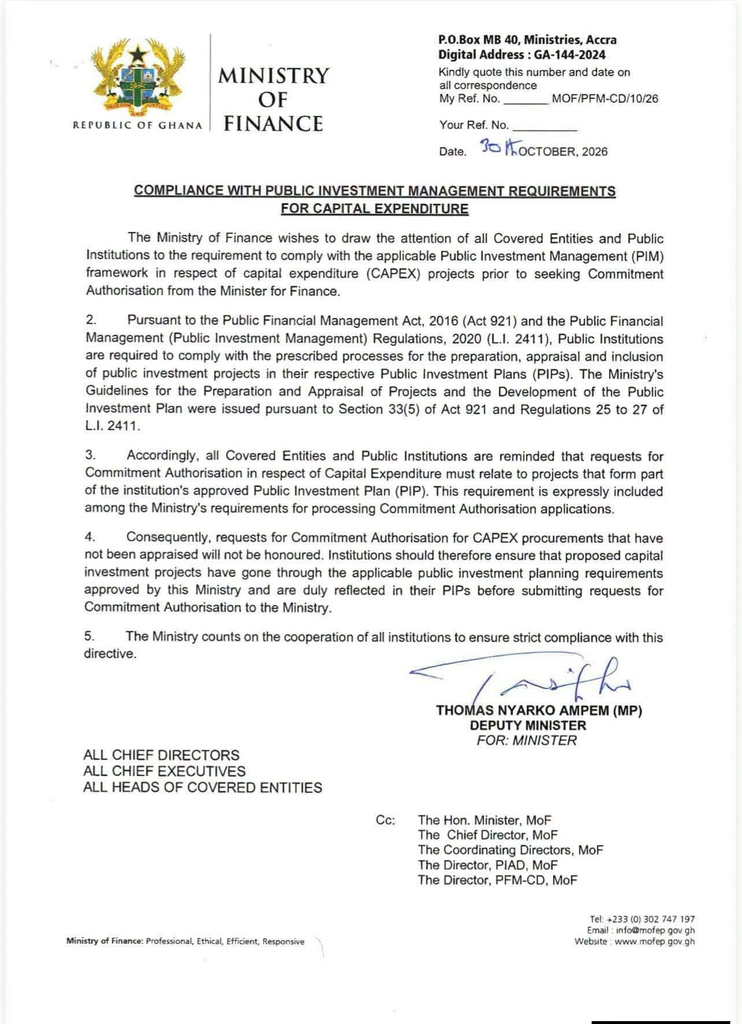
The Ministry of Finance has warned all Covered Entities and Public Institutions that it will no longer honour requests for Commitment Authorisation for capital expenditure (CAPEX) procurements that have not gone through the required Public Investment Management (PIM) processes.
In a circular dated 30th October, 2026, and signed by the Deputy Minister for Finance, Thomas Nyarko Ampem (MP), for the Minister, the Ministry reminded institutions of the requirement to comply with the applicable PIM framework in respect of CAPEX projects prior to seeking Commitment Authorisation.
The directive is issued pursuant to the Public Financial Management Act, 2016 (Act 921) and the Public Financial Management (Public Investment Management) Regulations, 2020 (L.I. 2411).
Under the law, public institutions must comply with the prescribed processes for preparing, appraising, and including public investment projects in their respective Public Investment Plans (PIPs). The Ministry’s Guidelines for the Preparation and Appraisal of Projects and the Development of the Public Investment Plan were issued pursuant to Section 33(5) of Act 921 and Regulations 25 to 27 of L.I. 2411.
Accordingly, the Ministry said all requests for Commitment Authorisation in respect of Capital Expenditure must relate to projects that form part of the institution’s approved Public Investment Plan (PIP). The requirement, it said, is expressly included among the Ministry’s requirements for processing Commitment Authorisation applications.
“Consequently, requests for Commitment Authorisation for CAPEX procurements that have not been appraised will not be honoured,” the circular stated.
Institutions must ensure that proposed capital investment projects have met the applicable public investment planning requirements approved by the Ministry and are duly reflected in their PIPs before submitting Commitment Authorisation requests to the Ministry.
The Ministry said it counts on the cooperation of all institutions to ensure strict compliance with the directive.
Read the full statement below:



About The Author